
Adapted Vehicles vs Accessible Vehicles: An Overview
As demand for wheelchair vans, mobility vehicles, and ADA-compliant transportation continues to rise, buyers face an important decision early in the process: Should you choose an adapted vehicle or a fully accessible vehicle? While these mobility options can look similar on the surface, the differences in cost, design, performance, and long-term value are significant.
Choosing the right type of vehicle affects safety, comfort, reliability, serviceability, and total cost of ownership. In this guide, we’ll explain:
- What adapted and accessible vehicles are
- Key features and pros/cons of each
- Cost factors and long-term value
- Which option best fits different use cases
- Where to compare both options in person
Southern Bus & Mobility has decades of experience helping individuals, families, and commercial organizations choose the right mobility vehicle, and this guide provides the foundational knowledge to help you make a confident decision.
What Is an Adapted Vehicle?
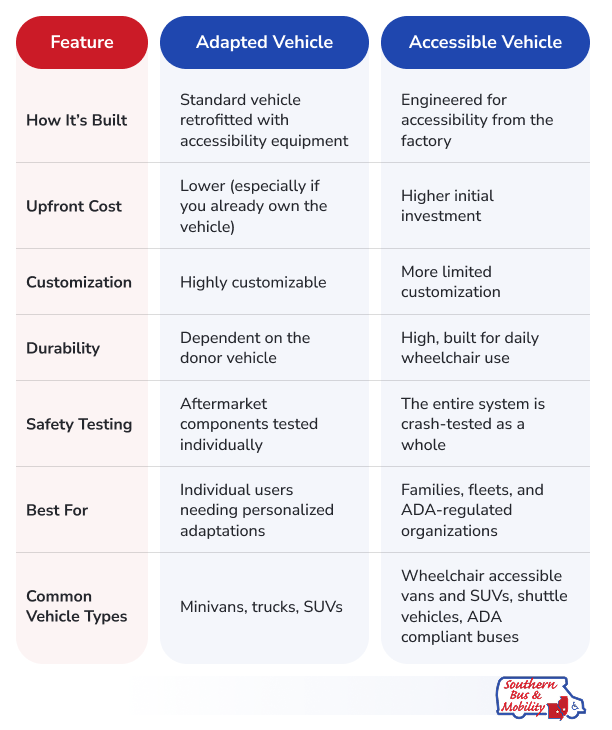
An adapted vehicle, also known as a retrofitted mobility vehicle, is a standard minivan, SUV, pickup truck, or full-size van that is modified after it leaves the manufacturer. These modifications make a standard vehicle accessible or drivable for a person with a disability.
Adapted vehicles let people start with a vehicle they already own or prefer, then add only the mobility equipment they need.
Key Features of Adapted Vehicles
Common retrofits include:
- Wheelchair lifts or ramps
- Hand controls and adaptive driving systems
- Lowered floors or raised roofs
- Swivel or transfer seats
- Wheelchair tie-down systems and docking stations
- Steering aids, pedal extenders, and alternative accelerator/brake controls
Adaptations are chosen based on the user’s needs, physical abilities, and preferred driving setup. Not every vehicle can be modified, but many popular models, including minivans, full-size vans, and certain trucks like the Chevrolet Silverado or GMC Sierra, are commonly adapted.
Many of these upgrades can be installed through a certified mobility technician at Southern Bus & Mobility’s Parts & Service Center.
Pros of Adapted Vehicles
- Convert an Existing Vehicle: Perfect for individuals who already own a compatible vehicle and want to avoid purchasing a new one.
- Highly Customizable: Adaptations can be tailored to specific disabilities, allowing for a personalized mobility setup.
- Lower Upfront Cost: Using your current vehicle often results in a significantly lower overall cost than purchasing a factory-built accessible vehicle.
Cons of Adapted Vehicles
- Dependent on the Donor Vehicle’s Reliability: If the base vehicle is aging or has mechanical issues, adaptations may add stress and reduce long-term durability.
- Compatibility Limitations: Not all makes and models are structurally suitable for retrofitting, especially smaller SUVs or unibody vehicles.
- Variable Resale Value: Because modifications are user-specific, resale value depends heavily on the vehicle’s age, condition, and equipment.
Ideal Use Cases
Adapted vehicles are best suited for:
- Individuals who already own a compatible vehicle
- Drivers needing specific types of adaptive controls
- Families tailoring a vehicle to one primary mobility user
- People interested in pickup truck conversions (Chevrolet Silverado, GMC Sierra)
What Is an Accessible Vehicle?
An accessible vehicle, also known as a wheelchair accessible vehicle (WAV), is built from the ground up with accessibility in mind. Instead of adding equipment to an existing vehicle, the manufacturer designs the frame, flooring, ramp system, interior space, and safety components specifically for wheelchair users. Accessible vehicles are available in both side-entry and rear-entry configurations, offering options for personal, family, and commercial use.
Key Features of Accessible Vehicles
These vehicles commonly include:
- Integrated, crash-tested ramps or lifts
- Reinforced floors, frames, and door structures
- Spacious interiors for maneuverability
- ADA-compliant equipment for commercial operators
- Optimized placement of grab handles, anchor points, and safety restraints
Because accessibility is engineered into the design rather than added later, these vehicles often outperform adapted vehicles in both durability and long-term reliability.
Pros of Accessible Vehicles
- Superior Durability: Built to withstand frequent loading and unloading, daily wheelchair use, and high-mileage service environments.
- Better Safety Performance: Ramps, flooring systems, and restraint equipment are crash-tested as part of the complete vehicle, not as aftermarket additions.
- Ideal for Fleets and Organizations: Perfect for senior living centers, schools, NEMT providers, municipalities, and ADA-regulated industries.
Cons of Accessible Vehicles
- Higher Purchase Price: Engineered mobility components increase upfront costs.
- Less Customization: While configurations vary, customization is generally more limited than aftermarket retrofits.
Ideal Use Cases
Accessible vehicles are ideal for:
- Commercial fleets (senior living, NEMT, shuttle services, hotels, schools)
- Families requiring long-term reliability and daily use
- Organizations that must meet ADA compliance
Price & Value Comparison
Understanding the cost differences between adapted and accessible vehicles is essential for making an informed decision.
What Impacts the Cost of Adapted Vehicles
Several factors influence the cost of retrofitting:
- Type and extent of modifications (ramps, hand controls, flooring, etc.)
- Age, condition, and model of the donor vehicle
- Labor and technology requirements for custom retrofits
- Additional safety equipment, such as tie-downs or transfer seats
Retrofit packages can range widely depending on complexity.
What Impacts the Cost of Accessible Vehicles
Factory-built accessible vehicles typically cost more because of:
- Engineering and manufacturing are designed specifically for accessibility
- Integrated ramps and lifts that undergo crash testing
- ADA-compliant components for commercial applications
- Higher capacity interiors for multiple passengers or wheelchairs
Though more expensive upfront, accessible vehicles often deliver stronger long-term value.
Long-Term Value Considerations
When comparing long-term ownership:
- Maintenance: Factory-built accessible vehicles generally require fewer structural repairs than retrofitted frames.
- Durability: Engineered mobility systems tend to last longer under daily use.
- Resale Value: Purpose-built accessible vehicles often retain value better because they appeal to a broader market.
- Total Cost of Ownership: Over 5-10 years, accessible vehicles may cost less overall due to fewer compatibility issues and reduced downtime.
Common Questions About Adapted vs Accessible Vehicles
What is the main difference between adapted & accessible vehicles?
Adapted vehicles are standard vehicles modified after purchase, while accessible vehicles are built from the factory with integrated wheelchair or mobility features.
Which option is more affordable?
Adapted vehicles can be more affordable if you already own a suitable vehicle to convert. However, factory-built accessible vehicles may offer better long-term value.
Are factory-built accessible vehicles safer?
Generally yes. Because their ramps, floors, and structures are engineered and crash-tested together, accessible vehicles often offer stronger safety performance.
Can any vehicle be adapted?
Not all vehicles are compatible. The make, model, size, and structural design determine whether safe mobility modifications can be added.
Explore Accessible & Adapted Vehicles at Southern Bus & Mobility
Whether you’re comparing mobility vehicle options for personal independence or searching for commercial ADA-compliant transportation, the experts at Southern Bus & Mobility can help you choose the right fit.
Contact us today to speak with a mobility specialist, schedule a visit, or request a demo. Our knowledgeable team, large inventory, and hands-on support make it easy to explore both adaptive and fully accessible vehicles to find the solution that offers the mobility and confidence you deserve.